
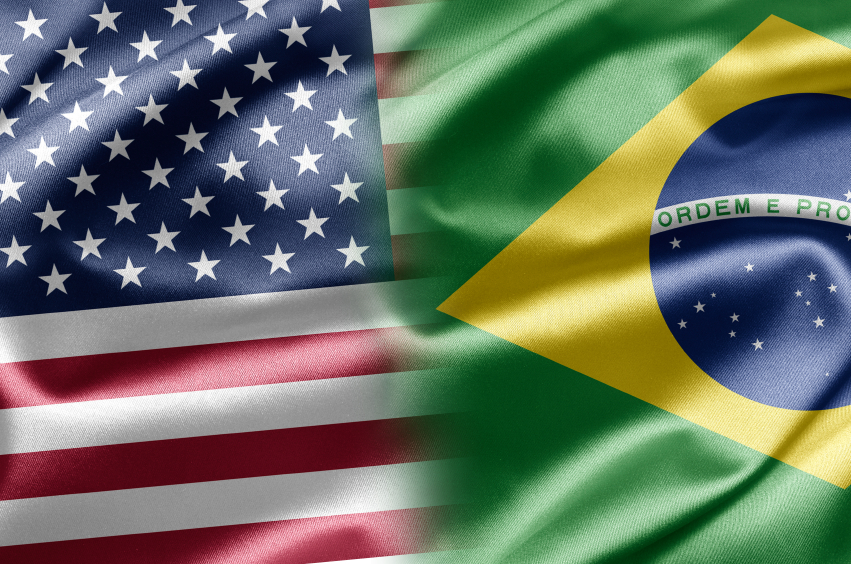
Girolami Legal Group, a global company from downtown San Diego presents “Doing Business in Brazil” at the World Trade Center San Diego (WTCSD).
On April 24th, Anthony Girolami discussed various aspects of doing business in Brazil and further explained current economic climate, taxation, human resources & employment law, key markets & trade, and incentives for foreign investors.
Brazil provides incentives for foreign investors that are accompanied by laws set in place to protect and welcome foreign businesses into the country. It is the big country we know little about and this giant is no longer slowly awakening—it is here and bustling with opportunities. Arguably the most prominent of the BRICS, Brazil has quickly developed as one of the world’s largest economies with an ever-growing consumer base that is hungry for new products and services. The country’s huge potential may be recent discovery for the rest of the world; however Brazilians have always known Brazil as the country of the future. The country’s capital, Brasilia was built around this concept which is clearly represented through the city’s Googie architecture.
Brazil is a peaceful country where everything ends in Samba, including business. Relationships take top priority in every aspect of life there. Brazil and U.S. have enjoyed continuous diplomatic relations since Brazil’s independence from Portugal in 1822 and were valuable allies during WWI and WWII. Although the two seem like natural partners, the U.S. still comes second to China as Brazil’s largest trading associate. This may not always be the case as this bi-lateral relationship is moving closer and there are opportunities to be had by all small and large businesses.
Although São Paulo leads the country as the industrial and financial center, it is not the only region offering opportunities for foreign investors. Rio de Janeiro is the center for oil while Minas Gerais stands as the third largest urban agglomeration and the center for mining as well as the biotech and high tech industry. Moving north, you will find Rio Grande do Norte standing strong with its impressive wind power market and a leading producer of cotton and fruit. Amazonas brings its free trade zone to the mix with manufacturing incentives and large ports that are geographically ideal due to its proximity to the markets in the northern hemisphere. The Brazilian government is currently pursuing development of industries in this area whose main focus will be to export consumer goods. This initiative is expected to have great economic impact throughout the entire country.
Currently, to be a Brazilian banker is a wonderful thing. The financial sector presents interest rates that are trending downward due to pressure from the government on banks to reduce them, and direct foreign investment has increased by 256% since 2005. For the first time in its history, the middle class is quickly emerging and is now the majority of the population. The rise in income and household not just in Brazil but in all of South America is ensuring a booming tourism industry for all. There is much to be said about the Brazilian tourism industry which is the second fastest growing in the world currently. This represents an increasingly important opportunity for all types of businesses. In 2010 alone, Brazilian tourists dropped $5.9 billion into the U.S. economy. It is expected that within the next four years Brazilians will no longer need a VISA to enter the U.S., which is not the case now. Currently, Brazilians are required to undergo a lengthy and costly process to acquire a Visa to enter the U.S.
Taxation, a beast vastly feared by foreign investors is also evolving. Currently, bi-lateral agreements are in discussion that will incorporate a tax treaty that will avoid double taxation, and a bilateral investment treaty to fuel green energy partnerships and biofuels cooperation. Further, Brazil is experiencing what they call a “Quiet Boom” in the real estate industry. Housing prices are rising, interest rates are at a historic low, and with a growing middle class there is more disposable income. There are major areas in need of some major development and an ever-growing demand for luxury housing and hotels. The Northeastern region of Brazil is largely undeveloped with a growing population and increased investment in oil and gas. There is a great need for quality, well planned housing similar to the popular concept of enclosed community homes in California. Consumers need more Shopping Centers and infrastructures while coast lines need resort development.
It is the law that foreign investment in Brazil be admitted freely and treated the same as local investments—any discrimination is illegal and actively enforced. Although foreign investment must be registered with the Central Bank of Brazil, investors are still allowed to take money out of the country to remit profits to their home country. There is no minimum time requirement, profits can be registered and a total amount earned can be taken out of the country without withholdings. Taxed at 15% capital gain, once that money leaves the country there is no additional income tax to be had.
Additional opportunities for collaboration in Brazil include smart metering and transmission technology, LED lighting on a municipal level, offshore support services – equipment and tech support, and concessions for offshore exploration and production. In 2008, the discovery of pre-salt offshore oil reserves (30-80 billion barrels) will turn this destination in a top 10 exporter by 2015. In the education sector, Universities should be taking full advantage of a new market for growth. The Brazilian government is currently paying full price and providing scholarships to 50,000 students to study in the U.S.
World Trade Center members can take advantage of WTC resources to meet potential Brazilian local partners. In addition, the American Chamber of Commerce in Brazil has been established for a long time and is very well developed. Contact Louzada Copy today for more information.
Daniela Louzada Esteves
 A Vertical Breakdown Inc.